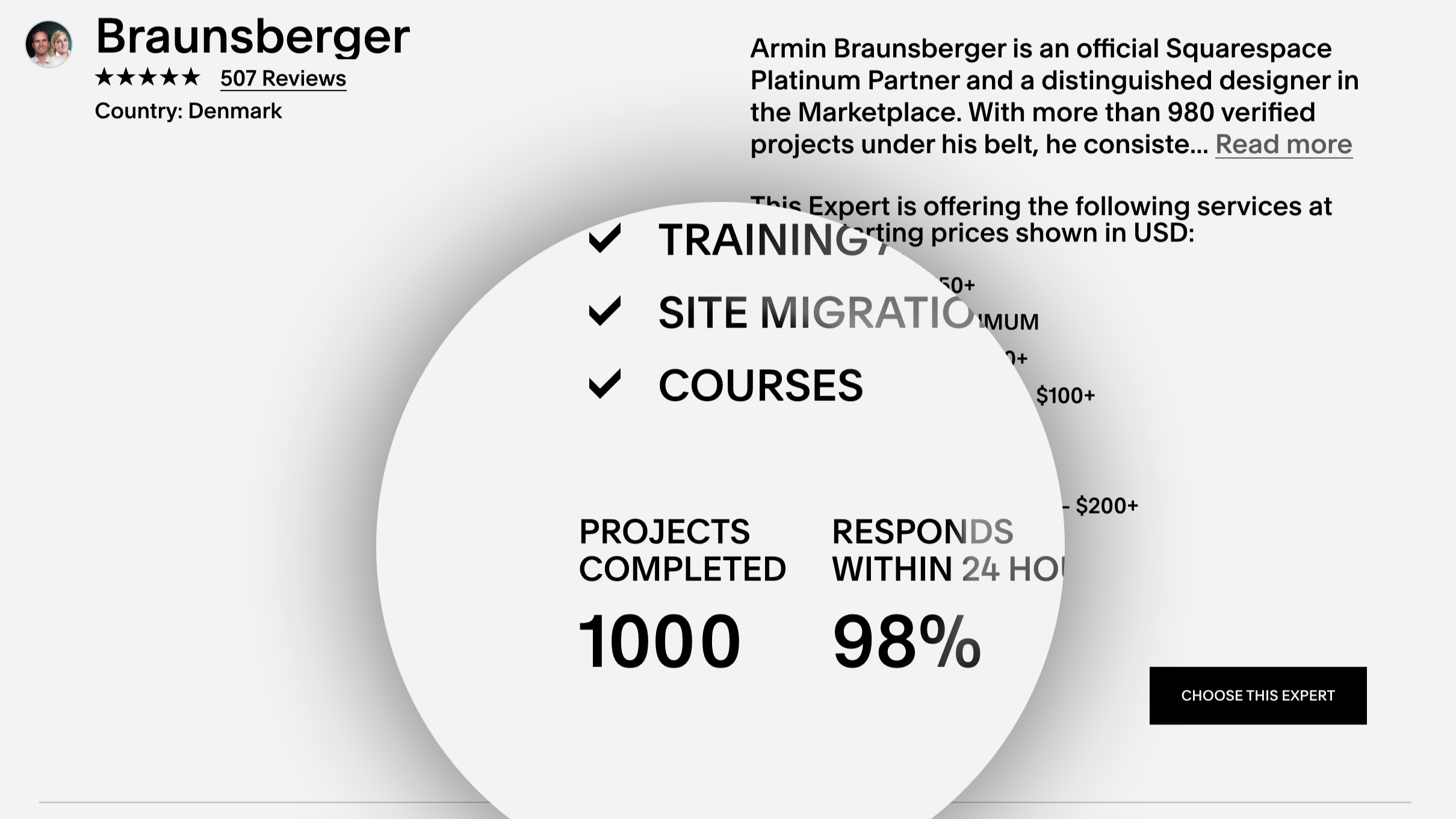
From Whiteboard Checkmarks to 1,000 Websites: How Braunsberger Media Became One of the World's Leading Squarespace Agencies
written by Armin Braunsberger
The first websites we tracked as an agency were listed on a whiteboard in our office. Hand-drawn checkmarks for completed milestones. No project management software, no automated workflows — just marker on board.
This month, we crossed1,000 completed projects on the Squarespace Marketplace. It's a number that still surprises us, honestly. Not because we didn't work for it, but because the path here looked nothing like we planned.
This is the story of how we got here — and what we actually learned along the way.
The Pivot That Changed Everything
Gloria and I didn't start as a Squarespace agency with our team. In the early years, we were developing websites across multiple CMS platforms — WordPress, Drupal, custom builds. The work was good, and the projects were ambitious. But we had a problem: we were heavily dependent on external developers.
That dependency caught up with us when a larger project collapsed. The details aren't important — what matters is what it taught us. We had built a business model where our success relied on people and systems we couldn't control. The design was ours, the strategy was ours, but the execution depended on external parties who didn't share the same standards.
That's when we made a decision that shaped everything after: we would focus on a platform that matched our strengths — design, strategy, and direct client relationships — and build the development skills in-house.
What Is Squarespace — And Why We Built Our Agency Around It
For those unfamiliar: Squarespace is a website platform that allows businesses to build and manage professional websites without needing to write code from scratch. It's known for clean design templates, a visual drag-and-drop editor, built-in eCommerce, and reliable hosting — all in one system. For small and medium-sized businesses, it removes the complexity of managing servers, plugins, and security updates that platforms like WordPress require. That said, Squarespace is often underestimated. With the right expertise, it's capable of far more than most people assume — custom code, advanced integrations, complex eCommerce setups, and high-performance SEO. That gap between what people think Squarespace can do and what it actually can do is exactly where we operate.
Over the following years, we went from a design-only and strategic agency to a team with deep in-house web development capabilities. Today, we don't just work within Squarespace — we push it. Custom code, advanced integrations, performance optimization. We turn templates into fully realized websites that serve a client's brand and business goals. No outside dependencies. No bottlenecks.
What Gloria Brings to the Table
If I'm the one people see on the Squarespace Marketplace, Gloria is the reason those projects actually succeed at scale.
Gloria Braunsberger is my co-founder and the strategic engine behind Braunsberger Media. She brings deep expertise in brand strategy, content creation, and SEO — and she's held the project lead on work for brands like Volkswagen, Red Bull, Porsche, and Audi, along with hundreds of small and medium-sized businesses.
When clients work with us, they get both perspectives. We focus on design, creative direction, and technical implementation. Gloria leads our digital performance—focusing on content quality, brand positioning, and ensuring the website actually performs—not just visually, but in search results and on AI-driven platforms.
This combination is what made our growth possible. A beautiful website that doesn't rank is an expensive brochure. A high-ranking website that looks generic won't convert. We've always believed you need both — and having those skills in-house, between the two of us, means clients get a cohesive result instead of fragmented outsourcing.
Design Meets Performance: Our SEO Evolution
In the early days, SEO was an afterthought for most web designers — including us. You'd build the site, maybe add some meta descriptions, and move on. That's changed completely.
Today, SEO and what we call AIO — AI Optimization — are woven into every project from the start. Gloria has driven much of this evolution. We don't offer SEO as a separate package that gets bolted on after launch. It's part of the strategy conversation from day one: keyword research, content architecture, technical performance, schema markup, and — increasingly — making sure a website is structured in ways that AI-powered search tools can understand and reference.
We use tools like Semrush for competitive analysis, keyword gap research, and ongoing monitoring. But tools are only as good as the strategy behind them. What makes our approach different is that we connect SEO to actual brand positioning. Gloria's content work doesn't just target keywords — it tells the client's story in a way that serves both human visitors and search engines.
For us, this was a natural evolution. Design and performance aren't separate disciplines — they're two sides of the same goal: making a website work for the people it's meant to reach.

Projects We're Proud Of
Over 1,000 projects, certain ones stand out — not always because they were the biggest, but because they represent what we do best.
Back to the Future — Official Website When Stephen Clark, the Executive Director of BTTF.com, reached out to us, the challenge was clear: an iconic website originally launched in 1995 needed to be brought into the modern web — without losing the spirit that fans around the world had connected with for decades. We migrated the site to Squarespace's Fluid Engine, implemented multi-language support through Weglot, and even built a custom randomizer script that plays a different movie trailer on each homepage load. It was a project that combined technical problem-solving with genuine respect for a beloved brand.
Tim Tadder — Advertising Photographer Tim is a distinguished advertising photographer and commercial director whose portfolio spans sports, portraits, and conceptual work — with campaigns for brands like Manscaped, Astro Gaming, and Hyperice. The website we built for him needed to do one thing exceptionally well: let the work speak for itself. We designed a structured portfolio system that organizes his photography and motion work into navigable categories while keeping the visual experience immersive and distraction-free.
How We Actually Manage 60 Projects at Once
People sometimes ask how we handle the volume with a team of four. The honest answer: systems.
We built our entire workflow around Monday.com. Every Squarespace Marketplace request email flows into our Monday system automatically. Since those emails follow a consistent structure, we extract the client name, the website URL, and the project link directly — no manual data entry. This means we can handle incoming requests personally while keeping everything technically organized from the first touchpoint.
I also use Claude AI connected to Monday.com regularly — for pushing data and feedback to projects, organizing tasks, and managing repetitive processes like copying phase structures across project boards. It saves hours every week that I'd rather spend on actual design work.
Communication speed matters when you're running dozens of projects simultaneously. I use an Elgato Stream Deck configured with text snippet hotkeys and speech-to-text, which keeps client communication fast without sacrificing the personal touch.
And consistent time tracking across every single project gives us real data — not guesses — for pricing, scoping, and identifying where our process can improve.
Why We'll Never Automate the Human Part
With all the tools and automation we use, there's one thing we won't touch: client communication.
I don't believe in AI-generated emails to clients. I don't believe in chatbot responses pretending to be a personal message. If someone trusts us with their business — their brand, their online presence, sometimes their livelihood — the least we can do is actually communicate with them.
The engine behind our 4.99-star average and 507 five-star reviews isn't a tool or a workflow. It's Zoom calls at every important project milestone. It's building trust quickly enough that clients are genuinely open to strategic advice — not just expecting pixel delivery.
Around 80% of our client base is located in the United States. We work from Denmark. Different time zones, different cultures, different markets. That only works if clients trust you — and trust comes from showing up, being available, and having real conversations about their goals.
Technology handles the workflow. The relationship is always human.
What 1,000 Projects Taught Us
If there's a single takeaway from reaching this milestone, it's this: the agencies that last aren't the ones that scale fastest. They're the ones that figure out what to automate and what to protect.
We automated the admin. We protected the relationship. We built the skills in-house. And we never stopped learning — whether that means adapting to AI-driven search, developing custom Squarespace tools, or expanding into new markets across Europe.
The whiteboard is long gone. But the checkmarks — the simple act of finishing a project and knowing it was done right — that hasn't changed. Here's to the next thousand.
Further Work